
Wednesday, April 22, 2026 | Today's Newsletter | Login
Flight Attendants Push for Unpaid Work Law
By Isaac Phan Nay,
Local Journalism Initiative Reporter
Eight months into Ottawa’s investigation into flight attendants’ allegations that they’re forced to do unpaid work, the union is raising concerns that it won’t result in any change.
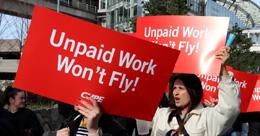
Ottawa launched its probe last August after Air Canada flight attendants walked off the job in part because they are not paid their hourly wage for work done before takeoff and after landing.
According to the Canadian Union of Public Employees, which represents approximately 20,000 flight attendants in Canada at airlines including Air Canada, WestJet and Porter Airlines, that’s standard practice in the airline industry.
The government says it’s committed to ensuring attendants make at least minimum wage.
Jeff Morrison, president and CEO of the employers’ group National Airlines Council of Canada, said in an emailed statement that the current system is already in line with labour laws and appropriately compensates attendants for all their work.
Still, the federal labour program, which is doing the review, is asking employers to self-audit their pay records as the investigation continues.
But Wesley Lesosky, president of the airline division of CUPE, said that lets employers cherry-pick data that’s favourable to them. He’s calling for the government instead to examine pay records from the union, explicitly define what constitutes work and make airlines pay attendants their hourly wage for all hours on the job.
“I have strong concerns, because the employers can hand-pick best case scenarios,” Lesosky said. “I don’t think this is going to get to the crux of the issue.”
According to CUPE, most airlines only pay attendants while airplanes are in motion. That means they’re often not paid for briefings at the gate, during safety checks at the terminal or while helping mobility-impaired customers board, all examples of what the union calls “ground work.”
Unpaid work was a key issue for Air Canada flight attendants during last year’s bargaining, which culminated in a three-day strike that grounded about 500,000 customers’ flights last summer.
Air Canada agreed to pay flight attendants for up to an hour of ground work before takeoff at half their normal hourly rates during the agreement’s first year, increasing to 70 per cent by the fourth year. With the agreement, Air Canada joined Delta Air Lines, Porter Airlines and Pascan, which are among the small list of companies that compensate flight attendants’ ground work.
But at other airlines, Lesosky said some flight attendants aren’t being paid minimum wage across all their hours worked. He added flight attendants should be paid at their full hourly rate for any work they do.
“Let’s say you work for a retail establishment,” he said. “If the employer requests you stay an extra 30 minutes, you have to be paid for that time.”
According to the latest available data in Canada’s Job Bank, flight attendants nationally earned anywhere from $15.35 to $75.98 per hour
Federal jobs minister Patty Hajdu launched the probe into whether or not flight attendants were doing unpaid work last August in response to the Air Canada strike.
In February, the federal government published a report on the first part of the probe.
In the report, the federal government said employers and employees agreed that ground work must be considered in pay schemes, but disagreed on how payment should be structured.
Employers said that their current pay already accounts for ground work. Meanwhile, according to the report, employee groups said the hours of unpaid work means some flight attendants are paid below minimum wage when their total pay is divided by their total hours worked.
In an email, Hajdu’s office said the government’s responsibility is to uphold the Canada Labour Code, which explicitly says employees must be paid at least minimum wage.
“While the first phase of the probe did not find evidence of a sector-wide failure to meet minimum wage standards, it identifies areas where compensation practices warrant closer examination,” Hajdu’s office said. “The findings underscore the need for further examination.”
Hajdu’s office added the government’s labour program will take a closer look at flight attendant’s pay structures to review whether it complies with the code.
According to the report, that means requesting airlines conduct self-audits of flight attendants’ pay records and investigate complaints raised by employees. If employers don’t conduct self-audits, the government said it may order them to conduct the audits or make them pay a fine.
“Our inspections will remain rigorous and uncompromising,” Hajdu’s office said. “Compliance with the law is not a suggestion.” The employer council’s Morrison put out a statement in response to the report. Morrison said so far, the probe has confirmed airlines do not avoid paying flight attendants for their work and validates the current system is in line with the Canada Labour Code.
“The findings clearly reaffirm what our member airlines have long recognized: flight attendants perform essential work across the full scope of their duties, and airlines compensate that work in accordance with collectively negotiated agreements and federal labour standards,” Morrison said.
Morrison added Canada’s airlines are committed to being transparent and engaging in the probe.
According to the February report on the investigation, some smaller carriers told the federal government the definition of “work” was unclear for flight attendants. Employee groups called for the government to introduce legislation that would explicitly define work, require airlines to pay for ground work and audit airlines to ensure they complied.
CUPE’s Lesosky said a clear definition of work and attendants’ duties is key to ensuring flight attendants are able to track extra time worked.
“The definition of our work needs to be number one,” he said. “If we don’t know what constitutes time working for your employer, we don’t know if we’re being paid adequately.”
Lesosky added it’s up to the government to create that definition of work through legislation.
In 2024, both the NDP and the Conservative Party of Canada introduced bills — C-409 and C-415, respectively — to address unpaid work in the airline sector. Neither bill was brought back to the House of Commons for a second reading, causing them to die when Parliament dissolved.
Last October, NDP MP Don Davies tried for a third time, and introduced a private member’s bill that would require airlines to pay flight attendants for ground work. But that bill hasn’t been debated since Davies introduced it.
Leave a comment