
Wednesday, October 21, 2026 | Today's Newsletter | Login
SPECIAL REPORT - Inside Project Severo
How a major RCMP national security prosecution, launched amid a public outcry over China’s interference in Canada, was hobbled even before the trial opens.
By Fabian Dawson
Mata Press Service
A major national security prosecution tied to allegations of China’s interference in Canada is set to open in Vancouver this week, with the RCMP’s case already badly weakened by pre-trial rulings that have cut into the core of the investigation.
With the pre-trial rulings now reportable, the case against former RCMP inspector William Majcher opens with a judge having already found his arrest unlawful and a warrant to search the home of an alleged unindicted co-conspirator invalid.
The judge has also prevented the crown from using similar fact evidence to advance their prosecution of Majcher while finding that key parts of the police theory were based on speculation, source material and media reports that were not properly verified.
The allegations are rooted in China’s so-called ‘Fox Hunt’ campaign, a global effort by Beijing to locate and return individuals accused of economic crimes. Canadian authorities have said those operations can involve pressure tactics that fall outside normal legal channels.
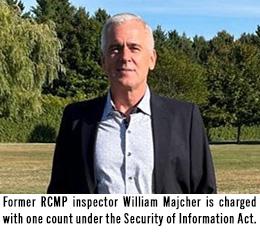
Majcher is charged with one count under the Security of Information Act. The Crown alleges that in May and June 2017, he acted at the direction of, for the benefit of, or in association with authorities in the People’s Republic of China in an effort to induce Vancouver-area businessman Hongwei “Kevin” Sun to repatriate himself and his assets to China.
Sun, however, has publicly said he was never approached or pressured by Majcher and had no connection to him in that context.
Majcher, a decorated undercover officer specializing in money laundering and financial crimes, served 23 years in the RCMP and retired as an Inspector, before moving to Hong Kong.
His contention is that the entire case against him is "nothing more than suspicion, speculation, hypotheses and guesswork" by the RCMP.
The RCMP investigation also swept up Kenneth ‘Kim’ Marsh, a retired Mountie who was publicly identified as an unindicted co-conspirator in the matter, never charged, had his Vancouver home searched in June 2023, and has now been subpoenaed to testify. The case has already transformed him from investigator to target to witness.
Marsh is a veteran Mountie who retired after a 25-year career, having served as a commander of an undercover unit and recognized for his work in private investigations, anti-money laundering compliance, and for speaking out regarding foreign interference in Canada.
Charges against Majcher were first laid in Longueuil, Quebec in July 2023, as part of an RCMP national security investigation dubbed Project Severo, before the case later moved to British Columbia, where the alleged conduct and key investigative steps were centred.
Quebec Case Stalls
The first major setback for the Crown came in Quebec, where the prosecution was initially launched.
In June 2024, Quebec Superior Court Justice François Dadour found there was a serious issue as to whether Quebec was the proper jurisdiction to lay the charges, noting that Majcher was neither present in nor connected to the Longueuil district and that no clear territorial nexus had been established. The court did not decide the issue on the merits of the case but ordered a stay of proceedings, effectively halting the prosecution in Quebec in August 2024.
The original information in the charges against Majcher included multiple counts, including a broad conspiracy allegation spanning several years and jurisdictions that named Marsh as an unindicted co-conspirator.
The Crown subsequently abandoned that proceeding and refiled a single, narrower count in British Columbia, focused on a five-week period in May and June 2017. The allegations naming Marsh were no longer pursued.
The case reshaped
The next major judicial setback came months later in British Columbia.
In October 2025, Justice Martha Devlin rejected the Crown’s attempt to introduce similar fact evidence, including a large body of emails tied to Majcher’s alleged work involving Chinese authorities in Canada and abroad and activity linked to a U.S.-based target.
This ruling prevented the Crown from relying on a broader narrative of international conduct, including material drawn in part from unverified media sources, and confined the case to what could be directly proven on the allegations centred around Kevin Sun.
The ruling narrowed the RCMP case significantly. It prevented the Crown from relying on narrative-driven or pattern-based evidence, including material tied to alleged conduct outside Canada and sources drawn in part from international reporting, and confined the prosecution to what could be directly proven on the facts of the case.
Search and Arrest
On Dec. 31, 2025, Justice Devlin ruled that the warrant used to search the Vancouver home of Marsh could not properly have been issued. The judge found the information presented to obtain the warrant disclosed “nothing more than mere speculation, suspicion and guesswork” and was incapable of providing the evidentiary foundation required by law.
She ruled the search breached section 8 of the Charter, which protects against unreasonable search and seizure. The ruling may also have implications for other warrants used in the investigation, if they relied on the same underlying theory and evidentiary foundation.
The second major Charter ruling came on March 26, 2026.
In this ruling Justice Devlin found that Majcher’s arrest at Vancouver International Airport in July 2023 was carried out without reasonable and probable grounds. The arrest breached section 9 of the Charter, which protects against arbitrary detention.
The judge accepted that the lead investigator, Staff Sgt. Nicolas Ferland, believed there were grounds to arrest, but found that belief was not objectively reasonable.
The ruling also recorded that the RCMP file was described internally as “a bit premature” and “still ongoing” at the time the decision to arrest was made.
A Consistent Pattern
Read together, the pre-trial rulings undercut both ends of the same investigation, the search that gathered evidence and the arrest that pushed the case forward.
They also expose a deeper problem. The court record shows that key parts of Project Severo’s theory were built on media reporting, documentaries, open-source narratives and speculative associations that police either did not verify or could not properly connect to criminal conduct.
One of the clearest examples involves former RCMP officer Calvin Chrustie. According to court records, investigators recorded that Chrustie had contacted them and was later interviewed. He told police he had known Majcher since they were troop mates in training but had distanced himself from him. He described Majcher’s ties to Marsh’s private sector work after a visit to the latter’s office.
The RCMP then used Chrustie’s account to support the inference that Marsh may have been Majcher’s “go to guy” in Canada for “locating someone or something.”
Justice Devlin rejected that reasoning, finding that the inferences were based on bare assertions and speculation and did not advance the grounds necessary to issue the warrant.
The same pattern appears elsewhere in the case. One of the three main pillars of the arrest theory came from an Australian Broadcasting Corporation’s Four Corners program. Justice Devlin records that the lead investigator relied on that broadcast and that his understanding of the alleged connections was derived from it. The court noted that investigators failed to verify any of the information relied upon and did not obtain underlying records to support it.
The same pattern also appears in the Yan Shibiao strand of the case. That strand centres on a civil case in B.C. involving asset recovery. Investigators connected Marsh’s earlier work to the matter through media reporting, but the court record shows the inquiry effectively ended after limited steps, and that nothing available to investigators tied Majcher to any coercive conduct.
That matters because the Yan matter was framed by police as something more serious than what the evidence supported. The search warrant materials show RCMP using public-record investigation and a civil process to draw a criminal inference, which the court later rejected.
The Kevin Sun strand followed a similar path. Public reporting around Sun predates Project Severo by years, including a Vancouver Sun expose describing his business dealings.
In the police records, Sun is presented as a central figure in the alleged foreign interference scheme. But the court found there were too many gaps in the police narrative to support a reasonable inference that Majcher was involved, or that the cancellation of Sun’s Interpol Red Notice was connected to either him or Marsh.
The problem was not limited to what investigators relied on. It also extended to how the case was presented publicly, where media amplification at times moved ahead of verification.
One of the clearest examples came in 2024, when journalist Sam Cooper published a story on The Bureau claiming Majcher had been photographed in Macau shaking hands with alleged Chinese triad figures, including Tse Chi Lop. The story was later retracted after it emerged that the image was not casino security footage at all, but a still from the 2015 film From Vegas to Macau II. The man in the frame was not a gangster but actor Chow Yun-Fat.
That episode is not part of the court rulings themselves, but it underscores a broader reality around this case. The public narrative surrounding Majcher and Marsh has repeatedly been shaped by allegations, inferences and media material that either collapsed under scrutiny or were never independently verified in the first place. The courts have now raised similar concerns about the evidentiary foundation of the police case.
In the search-warrant ruling, Devlin found the police theory did not provide a basis to conclude that either Majcher or Marsh had committed an offence. In the arrest ruling, she found the same core theory did not rise to the level required to justify arrest.
Trial Set to Open
That is what makes the opening of this trial so unusual.
The Crown still has an indictment and still intends to proceed. But this is no longer a case opening on the strength of a national-security theory alone. It opens with a judge having already found that the warrant used to search Marsh’s home was invalid, that Majcher’s arrest was unlawful, and that major parts of the evidentiary narrative were built on material the police did not properly verify.
“The result is a multi-million-dollar foreign interference investigation and prosecution that arrives in court with its foundation already shaken,” said retired Vancouver police officer Paul McNamara, who has been following the case.
He pointed out that Majcher’s arrest came during a period of intense political pressure on the Trudeau government to respond to allegations of Chinese interference in Canada.
“My concern is that the RCMP got caught up in the anti-China climate of the time, failed to investigate with the rigour this case required, and the prosecution allowed that theory to keep moving forward. That should concern every Canadian,” said McNamara
Fabian Dawson is a veteran Vancouver-based journalist who has been following this case for the last four years. During his tenure as the deputy editor of the Vancouver Sun and The Province, he has worked with both William Majcher and Kenneth Marsh, on several media investigations.
Leave a comment